The 2026 Job Market Feels Broken for Applicants — Here’s Why
A practical look at the 2026 job market, why ghosting feels worse for applicants, and how to protect your time, follow-ups, and application Q&A in a slow hiring environment.
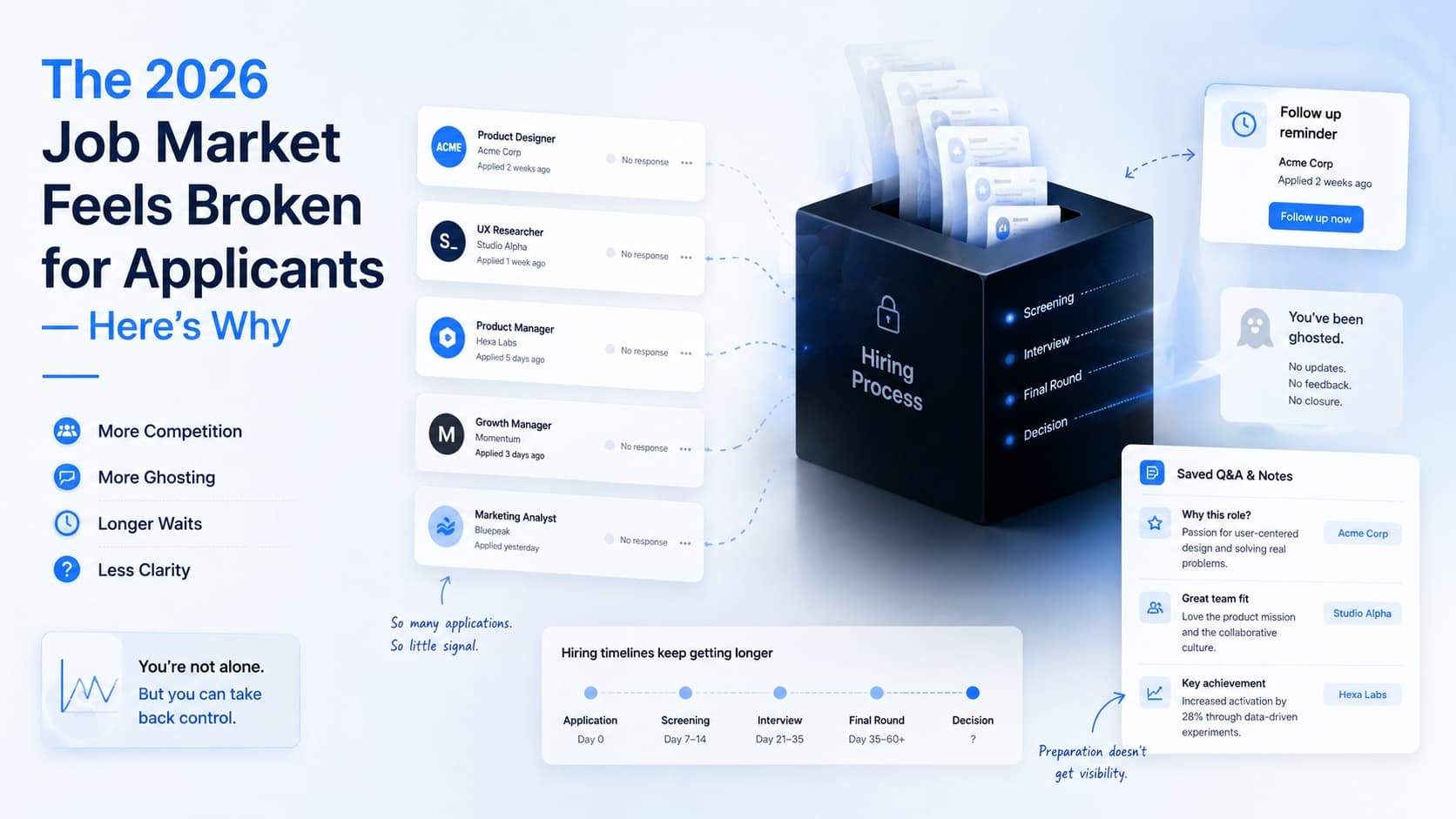
The short answer is simple:
The 2026 job market feels broken for many applicants because hiring is slower, competition is higher, and a large share of applications still disappear into silence.
That silence has a name now: ghosting.
It happens after you apply. It happens after recruiter screens. It happens after interviews. And in a slower, more selective market, it creates a second problem that people do not talk about enough: applicants start losing their own context too.
They forget which resume they used. They forget what the application asked. They forget how they answered. They forget when they meant to follow up. And once that happens, a difficult search becomes even harder to manage.
The 2026 job market is still active, but it feels worse from the applicant side
Hiring has not stopped. But for applicants, the process often feels less predictable, less responsive, and less transparent than it used to.
There are a few reasons for that:
- more people are applying broadly
- remote jobs attract larger pools
- companies are moving more carefully
- internal approval cycles are longer
- many applications are filtered before a human ever reviews them
That combination creates a market where jobs still exist, but the path from application to response feels much weaker.
LinkedIn said in January 2026 that U.S. applicants per open role had doubled since spring 2022, while 65% of people said finding a job had become more challenging.
What matters for the reader is not just the macro trend. It is the lived experience of the search:
- more waiting
- more uncertainty
- fewer useful signals
- more time spent applying without knowing what is real
That is why so many job seekers say the market feels broken even when headlines say hiring is still happening.
Why ghosting feels worse in 2026
Ghosting is not new. What feels different now is the scale and the normalcy of it.
In a high-volume market, many employers simply do not close the loop. Some never reply at all. Some reply only if you reach a later stage. Some pause roles internally and leave applicants hanging without a clear rejection.
The result is that silence becomes part of the default experience.
That pattern is showing up in applicant research too. In LinkedIn's January 2025 job-search research, 37% of job seekers said they were applying to more jobs than ever but hearing back less.
1. Higher applicant volume reduces communication
When one role pulls in dozens or hundreds of applicants, employer communication usually gets worse, not better.
That does not excuse it. But it does explain why so many people hear nothing after applying.
The volume problem is especially sharp in remote hiring. Jobgether reported in late 2025 that remote roles were receiving 3x to 6x more applications than on-site roles, and that applicants per posting had tripled on its platform.
2. Screening happens earlier and more automatically
Many job seekers are now filtered before a human recruiter ever reviews their materials.
That means you can be eliminated quickly without ever getting a meaningful signal back. From the applicant perspective, it feels exactly like being ignored.
That perception is reinforced by how applicants view AI in hiring. Criteria's 2025 candidate experience findings said 31% of candidates felt negatively about employers using AI during hiring, and 40% had already adjusted their resume to compensate for AI screening tools.
3. Hiring cycles are longer and more fragile
A role may be open, then slowed, then paused, then reopened, all while the listing remains live.
Applicants only see one thing: a job post that looked active and a process that stopped moving.
Even the broader labor data reflects a more hesitant market. U.S. Bureau of Labor Statistics data for June 2025 showed 7.4 million job openings but only 5.2 million hires, which helps explain why many listings do not translate into clear forward movement from the applicant side.
4. Some listings are not moving with real urgency
One reason ghosting feels especially demoralizing is that not every posted role behaves like an active search.
Some listings may stay up while companies build pipelines, test compensation, or keep optionality open. Applicants cannot easily tell which jobs are truly moving and which ones are effectively stalled.
The safest definition comes from the Congressional Research Service, which described ghost job postings in April 2025 as postings for positions that either do not exist or that employers are not planning to fill immediately.
This is one reason visibility matters so much. The hardest part of ghosting is often not the rejection. It is the ambiguity.
The different kinds of ghosting applicants face
Ghosting is not one moment. It can happen at almost every stage of the search.
In a 2025 Stepstone survey, 64% of jobseekers said they had been ghosted by companies after applying, which shows just how normalized silence has become.
After applying
This is the most common version. You send the application, maybe get an automated confirmation, and then nothing else.
That lines up with the Stepstone data: 44% of applicants said the ghosting happened immediately after they submitted their documents.
After a recruiter screen
You have a call, exchange a few emails, and think the process is moving. Then it goes silent.
After interviews
This is often the most frustrating version because now you have invested real time in prep, scheduling, and mental energy.
After final rounds
This is less common, but it happens often enough that candidates now talk about it openly. Silence after a final round leaves people stuck between hope and uncertainty in the worst possible way.
Even earlier interview stages are not immune. The same Stepstone survey found that 9.5% of applicants received no feedback after their first interview.
What ghosting actually does to job seekers
The obvious cost is time.
The less obvious cost is decision quality.
When you keep hearing nothing, you start changing your behavior in ways that are not always helpful:
- applying to more roles without improving focus
- second-guessing every resume version
- delaying follow-ups because you are not sure what is appropriate
- holding old applications open mentally long after they are stale
- losing track of what each company asked and what you told them
Over time, this creates burnout.
It also makes the search less intentional. Instead of managing a pipeline, you start reacting to silence.
And applicants are feeling that strain directly. LinkedIn's 2026 research found that 65% of people said finding a job had become more challenging, with competition named as the biggest hurdle.
Why saving application Q&A matters more in a ghosting-heavy market
This is one of the most overlooked parts of job searching right now.
Many applications now include short written questions:
- Why do you want this role?
- Tell us about a time you solved a difficult problem.
- Why are you interested in this company?
- Describe your relevant experience.
Most people answer those questions once and never save them.
That is a mistake, especially in a market where you may apply to many roles and hear back weeks later.
If you do not save your application Q&A:
- you forget how you positioned yourself
- you lose useful material you could reuse later
- you risk contradicting yourself in recruiter calls
- you waste time rewriting similar answers from scratch
In other words, ghosting does not just create silence. It creates memory loss across your own search.
This is why a serious tracking system should store more than job titles and dates. It should also preserve:
- written application answers
- recruiter context
- resume version used
- follow-up timing
- interview notes
That context becomes more valuable, not less, when the market gets slower and noisier.
Continue with JobLumy
Track the parts of your search people usually lose
JobLumy helps you save application Q&A, follow-ups, notes, resumes, and job outcomes in one place so silence does not turn into lost context.
What applicants can realistically do about it
You cannot control how companies behave. You can control how much clarity you keep on your side.
Track every application in one place
At minimum, track:
- company
- role
- date applied
- current stage
- next action
- recruiter name
- job URL
- application Q&A
- notes
If you want a deeper framework, read What Is a Job Application Tracker and Do You Actually Need One?.
Save your written answers while they are fresh
This is the easiest high-leverage habit to add right away.
The moment a form asks a written question, save both the question and your answer. It will help with later applications, follow-ups, and interviews.
Move stale applications out of your active pipeline
One of the worst effects of ghosting is false momentum.
If a role has gone silent for weeks, mark it accordingly. Do not let dead or stalled applications clutter your active list.
Follow up strategically, not endlessly
One clear follow-up after a reasonable wait is useful. Repeated chasing usually is not.
Track the follow-up date, send it once, and then move on if the role stays silent.
Focus on signal, not just volume
In a market like this, blindly applying more is not always the answer.
Look for signals:
- recent posting activity
- signs the company is hiring with urgency
- whether you are getting recruiter engagement in a given segment
- whether a role has enough clarity to justify the time
This is also where applicant-side tools matter. A tracker is useful, but signal is what helps you decide where to keep investing effort.
The real problem is not just competition. It is lack of visibility.
Most applicants can tolerate rejection better than uncertainty.
What breaks people down is not always hearing “no.” It is hearing nothing while trying to make smart decisions in the dark.
You are expected to decide:
- which roles are worth tailoring for
- which companies are actually moving
- when to follow up
- when to mentally close a process
And you are often doing it with very little information.
That is why the 2026 job market feels broken from the applicant side. It is not only more competitive. It is harder to read.
Recruiters are feeling pressure too, but that does not change the applicant experience. LinkedIn found that 66% of recruiters said it had become harder to find qualified talent over the last year, while Greenhouse said in mid-2025 that recruiting teams were sometimes dealing with thousands of candidates per role. From the outside, applicants feel the result as slower responses, weaker communication, and more ghosting.
Final thoughts
The market is not completely dead.
But for applicants, it is often slower, noisier, and more ghost-heavy than it should be.
That changes what “being organized” means.
In a market like this, tracking is not just about counting applications. It is about preserving context:
- what you applied to
- what you said
- what happened
- what still deserves your attention
And when companies do not give you much visibility, that personal record becomes one of the few reliable sources of clarity you have.
If you want a practical companion piece, read How to Track Job Applications Without Losing Your Mind.
Frequently asked questions
Why do employers ghost candidates?
The most common reasons are high application volume, slower internal decision-making, weak candidate communication processes, and roles that lose momentum mid-search.
How common is ghosting in job applications?
It is common enough that many applicants now treat no response as the default outcome. In a 2025 Stepstone survey, 64% of jobseekers said they had been ghosted by companies after applying.
Is the 2026 job market bad or just competitive?
For applicants, it is both more competitive and harder to read. LinkedIn reported in 2026 that U.S. applicants per role had doubled since spring 2022, which helps explain why jobs can still exist while the search still feels more difficult and less responsive.
What are ghost jobs?
The term usually refers to listings that appear active but are not moving with real hiring urgency. The Congressional Research Service defines ghost job postings as roles that either do not exist or are not planned to be filled immediately.
What should I save from each application?
At minimum, save the job URL, resume version, date applied, current stage, next action, recruiter context, and any written application Q&A. Those details are the first things most people lose.