What Is a Job Application Tracker and Do You Actually Need One?
A clear explanation of what a job application tracker does, when spreadsheets stop working, and how job seekers can keep their search organized without losing context.
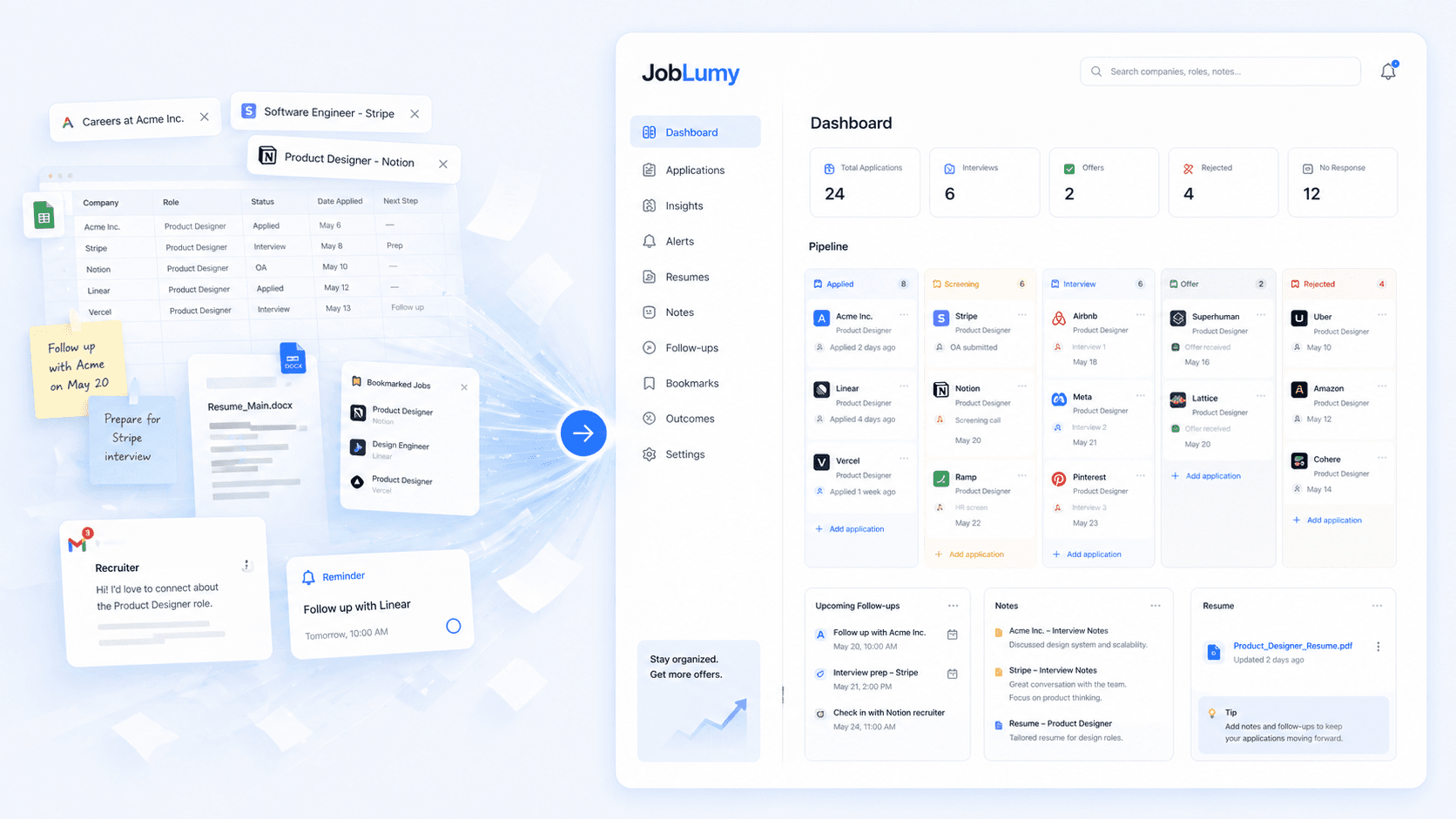
A job application tracker is a system for keeping your job search organized.
It helps you track which roles you saved, which jobs you applied to, what stage each one is in, what follow-up is due next, and what context you need before replying to a recruiter or stepping into an interview.
If your current workflow is browser tabs, saved links, notes, and memory, a tracker gives that process structure.
The short answer is this:
Yes, most active job seekers do need one.
Not because job tracking is complicated, but because job searches become fragmented faster than people expect.
What a job application tracker actually does
A good tracker helps you answer a few basic questions quickly:
- What jobs have I saved or applied to?
- What stage is each one in?
- What needs attention this week?
- When should I follow up?
- What notes or context do I need before the next step?
That is the real value.
It is not just about making a list. It is about reducing the effort it takes to understand your current pipeline.
Why job searches break down without one
The problem is usually not that people forget to apply. The problem is that the information around each application gets scattered.
One role lives in a spreadsheet. Another is saved in a browser bookmark. Interview notes are in a notes app. A recruiter message is sitting in your inbox. The resume you used is in a folder with five similar filenames. The application questions you answered are already gone because you never saved them.
That works for a short search.
It starts to fail when you are applying consistently and multiple things are moving at once.
Without a tracker, every next step takes extra reconstruction:
- re-opening the job post
- remembering when you applied
- checking whether you already followed up
- figuring out which resume version you sent
- trying to remember what questions the application asked and how you answered them
- trying to remember what happened in the last recruiter call
That friction adds up.
When a spreadsheet stops being enough
Spreadsheets are usually the first version of a tracker, and for some job seekers they stay good enough.
But spreadsheets start to feel thin when you want to track more than rows.
They are weaker when you need to keep:
- recruiter details
- multiple resume versions
- follow-up timing
- interview round notes
- application Q&A
- saved jobs that are not yet applied
- a clear sense of what is stale, closed, or still active
The real limitation is not the spreadsheet itself. It is the amount of manual upkeep it requires.
If a system takes too much effort to maintain, you stop trusting it. Once that happens, the search gets messy again.
What should a job application tracker include?
You do not need a bloated system. You need a reliable one.
At minimum, a useful tracker should let you store:
| Field | Why it matters |
|---|---|
| Company | Core search and memory anchor |
| Role title | Different roles need different prep |
| Job URL | Lets you revisit the original posting fast |
| Saved / applied date | Helps with timing and follow-ups |
| Current stage | Keeps the pipeline understandable |
| Next action | Stops applications from drifting |
| Application Q&A | Saves written answers you will likely want to reuse later |
| Notes | Preserves context for future steps |
As the search gets more active, other fields become more useful:
- recruiter name
- interview rounds
- resume used
- saved application answers
- follow-up date
- referral usage
- private notes
- outcome
The goal is not to track everything possible. The goal is to track the things you will actually need later.
Continue with JobLumy
Start tracking your applications in one place
If your search is already scattered across tabs, notes, and spreadsheets, JobLumy gives you a cleaner system for jobs, follow-ups, resumes, and notes.
Who actually needs one?
You probably need a job application tracker if:
- you are applying to more than 10-15 jobs
- you are using more than one resume version
- you have missed a follow-up before
- you are reopening inbox threads to remember context
- you are using spreadsheets, notes, and bookmarks together
- you cannot quickly summarize your active pipeline
Another simple test:
If someone asked you right now which applications are active, which ones need attention, and which ones are effectively dead, could you answer in under a minute?
If not, a tracker will probably help.
What is the difference between a tracker and a job board?
A job board helps you find opportunities.
A job application tracker helps you manage what happens after that.
That includes:
- saved jobs
- applied jobs
- stage changes
- follow-ups
- application Q&A
- recruiter context
- interview notes
- outcomes
This is why many job seekers still feel disorganized even when they use major job boards every day. Discovery is covered. Pipeline management is not.
Why applicant-side visibility matters
One reason the process feels frustrating is that applicants often have the least visibility.
Recruiters and hiring teams usually have:
- pipeline stages
- response timing
- internal status visibility
- candidate volume context
Applicants usually have a mix of memory, tabs, notes, and inbox threads.
A tracker does not solve the whole problem, but it gives you one important thing back: clarity on your side of the process.
That is also why applicant-first tracking tools are more useful than generic productivity systems. The context of a job search is specific, and the tool should reflect that.
Using JobLumy as a job application tracker
JobLumy is built around this idea.
It helps job seekers keep application context in one place instead of spreading it across spreadsheets, notes, folders, and browser tabs.
With JobLumy, you can track:
- saved and applied jobs
- notes and application Q&A
- recruiters and interview rounds
- follow-up context
- resumes used for each application
- career page alerts
If you want the tactical version of this topic, read How to Track Job Applications Without Losing Your Mind.
If you want to try a dedicated tracker directly, you can start here.
Do you actually need one?
If your current system is working, staying updated, and easy to trust, maybe not yet.
But if your search feels fragmented, repetitive, or mentally noisy, the answer is usually yes.
A job application tracker is not overkill. It is just infrastructure for a process that has become real enough to need one.
Frequently asked questions
Is a job application tracker only useful for large job searches?
No. It becomes more obviously useful as volume increases, but even a smaller search can benefit from having one clear system.
Can I use a spreadsheet instead of a job application tracker?
Yes. A spreadsheet is often the first version of a tracker. The tradeoff is that it usually becomes harder to maintain once your search needs more context.
What should I track for each application?
At minimum: company, role, job URL, date applied, stage, next action, and notes. If the application included written questions, save those answers too. They are one of the easiest things to lose and one of the most useful things to revisit later.
What is the biggest mistake job seekers make when tracking applications?
Letting dead or stale applications stay mentally open. That makes the active pipeline harder to understand and creates false momentum.
Key takeaways
- A job application tracker helps you manage the full search process, not just a list of jobs.
- Most active job seekers need one once the search becomes too fragmented to hold in memory.
- Spreadsheets can work, but they often start to break down as context grows.
- The best tracker is the one that makes next actions, follow-ups, and pipeline clarity easier.
- Applicant-side visibility matters, especially in a process where job seekers usually have the least information.