Best Job Application Trackers in 2026: Free and Paid Options for Job Seekers
A practical comparison of the best job application trackers in 2026, including free and paid options for job seekers who want to stay organized and stop losing track of applications.
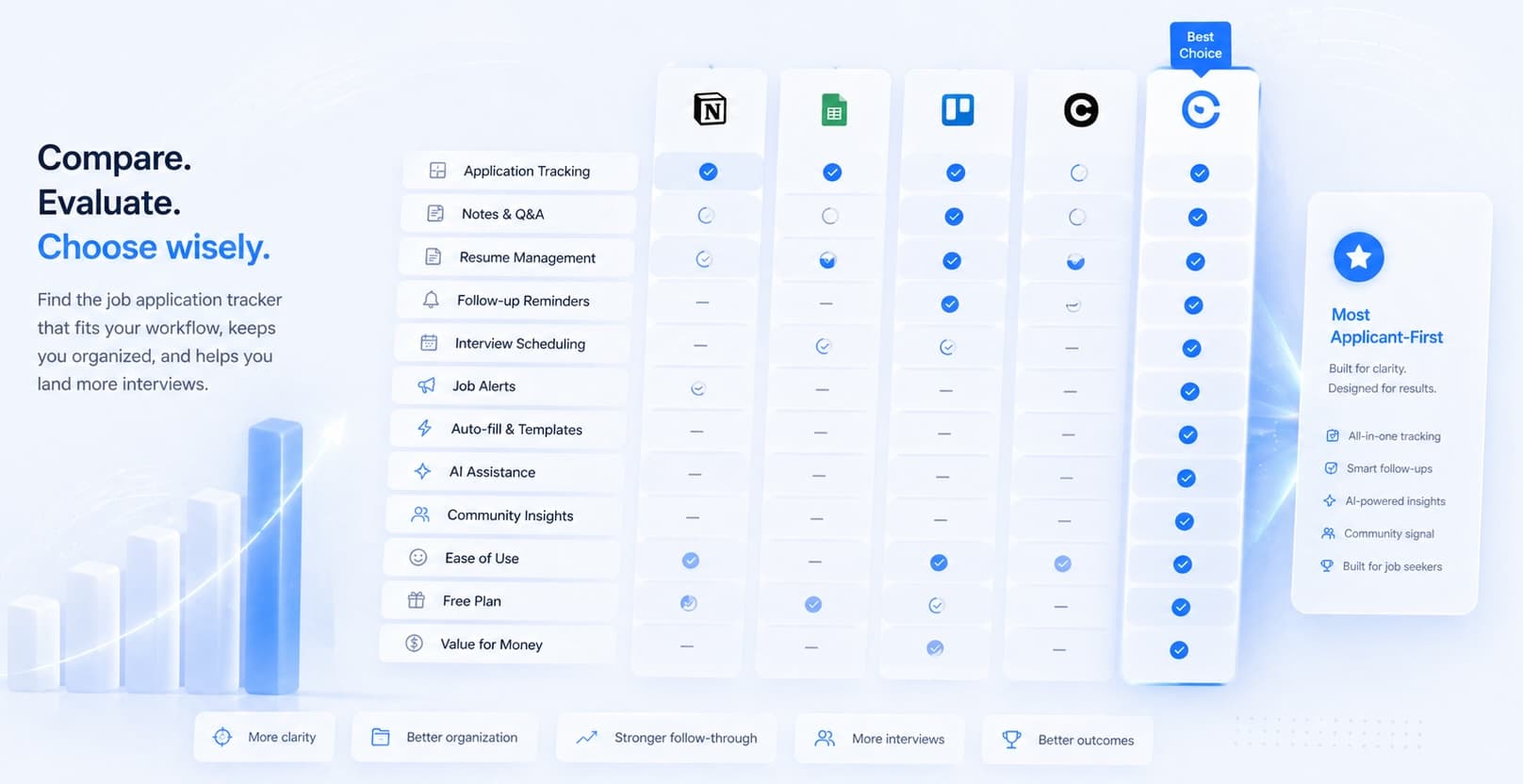
If you are serious about a job search, a tracker stops being optional pretty quickly.
Once you are juggling saved roles, applied jobs, follow-ups, recruiter messages, interview notes, written application answers, and multiple resumes, memory stops being reliable. Spreadsheets can work for a while, but they usually break down once the search gets more active and more context-heavy.
That is why dedicated job application trackers have become a real category.
This guide compares the best job application trackers in 2026, including both free and paid options. The goal is not to crown the flashiest product. It is to help you pick the tool that actually fits how you search.
Method note: features and pricing references in this article were checked against official product and pricing pages in April 2026.
Feature comparison
| Tool | Free plan | Application context | Career alerts | Autofill focus | AI tooling | Community insights |
|---|---|---|---|---|---|---|
| JobLumy | Yes | Yes | Yes | Coming soon | Coming soon | Yes |
| Teal | Yes | Yes | No | No | Yes | No |
| Huntr | Yes | Yes | No | Yes | Yes | No |
| Simplify | Yes | No | No | Yes | Yes | No |
| Careerflow | Yes | Yes | No | No | Yes | No |
Community insights are the clearest differentiator here. Most tools help you organize your own search. JobLumy is the only one in this comparison that is also designed to surface applicant-side signals when multiple people are tracking the same role. JobLumy's AI resume matcher and Chrome autofill extension are on the roadmap, but they are not live yet, so they are marked accordingly.
What makes a job application tracker worth using?
The best tracker is not the one with the longest feature list. It is the one that makes your search easier to continue tomorrow.
The tools in this list were judged mostly on:
- how easy they make it to track real applications
- whether they reduce spreadsheet and tab chaos
- how useful their free tier is
- whether they help preserve useful application context, not just job saving
- whether they are built for applicants instead of generic productivity use
Continue with JobLumy
See how JobLumy compares in practice
If you want applicant-first tracking, follow-ups, career alerts, and community insights in one workflow, you can try JobLumy directly instead of stitching tools together.
1. JobLumy
Best for: job seekers who want one place to track applications and get more applicant-side signal
JobLumy is the most applicant-focused product in this list.
It is not trying to be a giant general-purpose career suite first. The product is built around the actual workflow of tracking applications, saving context, managing follow-ups, and reducing the feeling of applying into a black hole.
What stands out:
- saved jobs, applied jobs, stages, and follow-up tracking
- notes, application Q&A, resumes, and recruiter context in one place
- career page alerts so you can watch company boards directly
- community insights when multiple applicants track the same role
- free core tracking workflow
Where JobLumy is strongest:
- if you want a tracker, not just a resume tool with a tracker attached
- if you want better visibility into what is happening around a role
- if you care about applicant-side clarity, not just application volume
Tradeoffs:
- it is earlier than some older incumbents
- if your top priority is AI resume generation or autofill across thousands of forms, some other tools on this list lean harder in that direction
If your biggest pain is scattered application data, lost application answers, and zero visibility, JobLumy is the strongest fit.
2. Teal
Best for: job seekers who want a polished all-in-one search system with strong resume support
Teal has become one of the most visible names in this category for good reason. Its free tier includes unlimited job tracking, and its product is clearly built around helping job seekers stay organized while improving application materials at the same time.
What stands out:
- unlimited job tracking on the free tier
- bookmarking, notes, goals, and application statuses
- resume builder and keyword matching
- interview tracking and networking CRM
- premium plans for more advanced AI and resume features
Where Teal is strongest:
- if you want a mature, structured workflow
- if you want tracking plus resume optimization in the same system
- if you like more guidance, templates, and polish around the process
Tradeoffs:
- the product is broader, which can feel heavier if you only want a lightweight tracker
- premium value is tied strongly to resume and AI tooling, not just tracking
Teal is a strong pick if you want an established product with a real free tier and a lot of built-in structure.
3. Huntr
Best for: people who want job tracking tightly paired with resume tailoring
Huntr sits in a similar lane to Teal, but feels more aggressively built around resume tailoring, autofill, and AI application materials.
Its free plan includes the job tracker, but the official pricing page currently limits the free tier to tracking up to 100 jobs, with Pro unlocking unlimited tracking and more advanced features.
What stands out:
- job tracker with notes, dates, salaries, and company data
- contact management and application autofill
- Chrome job clipper
- AI resume builder, tailored resumes, and cover letters
- map view and document uploads
Where Huntr is strongest:
- if you want a tracker that is closely tied to resume customization
- if you apply across many boards and want browser-extension help
- if you want a more feature-rich system than a spreadsheet without building your own workflow
Tradeoffs:
- the free tier is more limited than some alternatives
- the product can feel more like a resume-and-application suite than a pure tracking tool
Huntr is a good option if your workflow is application-heavy and resume-tailoring-heavy at the same time.
4. Simplify
Best for: high-volume applicants who want a very strong free plan
Simplify has a different angle from the others. It is built around the idea of one profile powering your search, with job matches, autofill, resume help, and tracking connected together.
What makes it stand out is the free positioning. Simplify says its base product, including unlimited job tracking and autofill, is free forever.
What stands out:
- unlimited free job tracking
- free autofill through the browser extension
- personalized job recommendations
- resume keyword support and AI resume builder
- strong fit for internship, new-grad, and high-volume application workflows
Where Simplify is strongest:
- if you apply to a lot of jobs quickly
- if autofill and speed matter more than deep tracking detail
- if you want a genuinely strong free option
Tradeoffs:
- it is broader than a tracker and pushes harder into discovery and application acceleration
- if you want deeper job-specific notes, alerts, or applicant-side insight layers, it is not as opinionated there
Simplify is one of the easiest recommendations on this list for people who want a strong free workflow with minimal friction.
5. Careerflow
Best for: job seekers who want an AI-heavy career toolkit around the tracker
Careerflow positions its tracker as part of a wider AI career platform. The tracker includes core organization features, but the broader pitch is about combining tracking with resume tools, LinkedIn optimization, follow-up help, and AI support.
What stands out:
- centralized tracking dashboard
- contact tracking, interview notes, and reminders
- job insights and one-click job import
- follow-up support and deadline reminders
- larger premium suite for AI resumes, optimization, and mock interviews
Where Careerflow is strongest:
- if you want tracking plus a wider career toolkit
- if you like AI assistance across more than one part of the search
- if you want reminders and CRM-style organization around applications
Tradeoffs:
- the product can feel more toolkit-heavy than tracker-first
- if you mainly want a simple, focused tracker, there are cleaner options
Careerflow makes the most sense for job seekers who want a broader platform rather than a pure tracking layer.
Which job application tracker should you choose?
The right answer depends on what is currently breaking in your job search.
Choose JobLumy if:
- your search feels scattered across tools
- you want one home for application context
- you care about follow-ups, alerts, and applicant-side visibility
- you want a free tracker built around applicants first
Choose Teal if:
- you want a polished all-in-one search workflow
- you care about resumes and tracking equally
- you want unlimited tracking on a mature free tier
Choose Huntr if:
- you want resume tailoring and application management tightly linked
- you rely heavily on extensions, autofill, and AI writing support
Choose Simplify if:
- you are applying at high volume
- you want the strongest free autofill + tracker combination
- you want speed and convenience first
Choose Careerflow if:
- you want a wider AI career toolkit around your tracker
- you want tracking, networking, optimization, and mock interview support in one place
The real question is not which tracker is best
The real question is which tool helps you stop losing context.
If your job search currently lives in a spreadsheet, a notes app, email threads, and browser tabs, almost any dedicated tracker will feel better than the DIY version.
But if you want a tracker built around the applicant experience itself, with follow-ups, career alerts, and community insights in the same workflow, JobLumy is the most opinionated choice in this list.
If you want to understand the category better first, read What Is a Job Application Tracker and Do You Actually Need One?. If you already know you need a system, How to Track Job Applications Without Losing Your Mind is the practical workflow guide.
Frequently asked questions
What is the best free job application tracker in 2026?
If you want the broadest free access, Simplify and Teal are both strong. If you want applicant-first tracking with follow-ups, alerts, and real signals, JobLumy is the better fit.
Are spreadsheets still good enough for job tracking?
They can be, but only while the search stays small and simple. Once you are managing multiple active applications, a dedicated tracker usually becomes easier to trust and maintain.
Should I choose a tracker or an autofill tool?
If your main problem is speed, choose a tool with strong autofill. If your main problem is losing context, including written answers from job applications, choose a tracker-first product. Many tools try to do both, but most still lean one way.